|
Extraordinary Council Meeting Agenda
7
April 2026
|
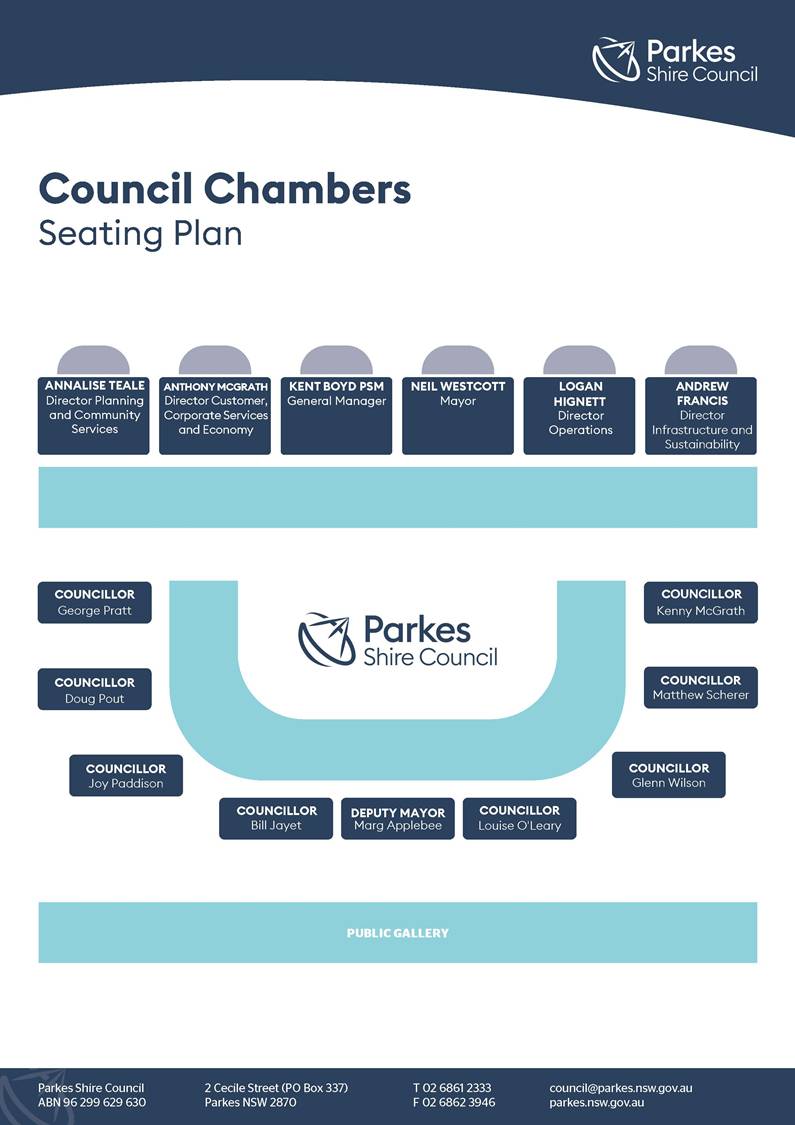
Governing Body
Composition: Ten
(10) Councillors
Membership: Councillor
WP Jayet, Councillor KM McGrath, Councillor LA O'Leary, Councillor J Paddison, Councillor
DJA Pout, Councillor GW Pratt, Councillor MK Scherer, Councillor GS Wilson
Quorum: 6
Councillors
Chairperson: Chairperson,
Councillor NC Westcott
Deputy Chairperson: Deputy
Chair, Councillor MA Applebee
Pursuant to section 223 of the Local Government Act 1993,
the role of Parkes Shire Council's governing body is:
To direct
and control the affairs of Parkes Shire Council in accordance with the Local
Government Act 1993, in consultation with the General Manager.
To provide
effective civic leadership to the local community.
To ensure as
far as practicable the financial sustainability of the Council.
To ensure as
far as practicable that the Council acts in accordance with the principles set
out in Chapter 3 of the Local Government Act 1993 and other strategic
plans, programs, strategies and policies of the Council.
To determine
and adopt a rating and revenue policy and Operational Plans that support the
optimal allocation of the Council’s resources to implement the strategic
plans (including the Community Strategic Plan) of the Council and for the
benefit of the local area.
To keep
under review the performance of the Council, including service delivery.
To make
decisions necessary for the proper exercise of the Council’s regulatory functions.
To determine
the process for appointment of the General Manager by the Council and to
monitor the General Manager’s performance.
To determine
the senior staff positions within the organisation structure of the Council,
following consultation with the General Manager.
To consult
regularly with community organisations and other key stakeholders and keep them
informed of the Council’s decisions and activities.
To be
responsible for ensuring that the Council acts honestly, efficiently and
appropriately.
Matters determined by meetings of Parkes Shire Council's
governing body will include all those non-delegable functions identified in
section 377 of the Local Government Act 1993.
|
Extraordinary Council Meeting Agenda
7 April 2026
|
9 Reports
of the Director Infrastructure and Sustainability
9.1 Lachlan
Duplication Pipeline Procurement Pre-Approval
IP&R
Linkage: Pillar: Environment
Goal: Our utilities are
well planned and effeciently managed.
Strategy: Provide
essential water and sewer infrastructure to meet the needs of our growing
community.
Author: Kylie
Trueber, Projects and Emergency Management Officer
Authoriser: Bikash
Paudel, Executive Manager Water Engineering
Annexures: Nil
|
Recommendation
That Council:
1. Note the report on
the procurement of pipe for the Lachlan Pipeline Duplication Project
2. Note that a
reduced tender period has been considered
3. Resolve that because
of the extenuating circumstances set out in the report a satisfactory result
would not be achieved by inviting tenders to submit a price and then await
the outcome of the submission.
4. Note that the
reasons for the decision of the Council in resolution 3 are as follows:
(a) The product with respect to
which the tender relates can only be provided by larger manufacturers
(b) Council has received expert
advice that due to the nature of the relevant market, offers from those
manufacturers which will be made in response to the request for tender will
only be open for acceptance for a period of 48hours
(c) Even if the tender period was
shortened to 7 days as permitted under the Regulations, some if not all the
relevant tenders would expire prior to Council being able to undertake an
assessment of tenders, report the matter to Council and resolve to accept or
reject any tenders.
(d) This would result in Council
either having no valid tenders which it is able to accept, or it would not be
able to consider for acceptance all of the tenders lodged in response to the
request for tender.
(e) This would not be a
satisfactory result for Council.
5. Delegate the
authority to execute the contracts for the supply of the pipe for the Lachlan
Pipeline Duplication Project to the General Manager.
6. Provide a report
to a future Council meeting on the outcome of the procurement process.
|
Background
Why a Two-Stage Tender?
Market Conditions and Geopolitical Considerations
Current global and geopolitical conditions
are creating ongoing volatility in construction material supply chains,
particularly for large-diameter pipeline materials. Key factors affecting
supplier pricing and availability include:
· Ongoing
geopolitical tensions and conflicts impacting global manufacturing and freight
routes
· Volatility
in energy prices affecting polymer production costs
· Disruptions
to international shipping, including longer transit times and higher freight
costs
· Reduced
willingness by suppliers to hold prices for extended periods due to market
uncertainty
As a result, many suppliers are:
· Limiting
the validity period of price offers
· Applying
escalation clauses or exclusions for delayed orders
· Prioritising
availability and delivery certainty over long-term fixed pricing
The proposed two-stage tender process allows Council to:
· First
confirm supplier capability, commercial alignment, and acceptance of terms
(Stage 1), and
· Then
seek current, market-tested pricing and availability at the point of commitment
(Stage 2)
· Achieve SSWP
milestone due 30th May 2026 for the execution of contract for the
supply of material.
· Allows
Council to test the market without price pressure
· Ensures
tenderers accept Council’s terms and conditions upfront
· Avoids wasted
pricing effort by non-compliant suppliers
· Improves
certainty on material availability and lead times
This approach reduces
Council’s exposure to price withdrawal, escalation risk, and supply
unavailability, while maintaining a transparent and competitive procurement
process
ISSUES AND COMMENTARY
Council is asked to consider whether the proposed
procurement approach, including delegating authority to the General Manager to
execute a contract outside standard tender timelines, is an appropriate and
proportionate response to current market conditions.
The primary issue is the volatility of raw material pricing
and the commercial reality that suppliers are only able to guarantee pricing
for very short periods. Council must consider whether adherence to standard
tender processes under these conditions would expose the project to avoidable
cost escalation and undermine value for money.
A related issue is the balance between competitive
procurement and financial prudence. While an accelerated procurement approach
may reduce competitive tension, delaying procurement is likely to increase
project costs and place pressure on the approved capital budget. Council must
weigh the risks of reduced competition against the higher likelihood of price
increases if procurement is deferred.
Council must also consider the financial and service
delivery consequences of delay. The Lachlan Pipeline Duplication Project is
critical infrastructure, and delays in securing pipe supply may impact
construction sequencing, project timelines and water security outcomes for the
community.
From a governance and compliance perspective, Council is
required to be satisfied that the proposed approach is lawful, defensible and
consistent with legislative and policy requirements. This includes ensuring
that the delegation of authority is clearly defined, approved by Council,
financially capped and supported by transparent reporting.
There is also a reputational consideration, as alternative
procurement approaches can attract scrutiny if not clearly justified. Council
must consider how the decision will be perceived by the community and whether
the rationale demonstrates sound stewardship of grant funds.
Finally, Council should consider its risk appetite and
precedent. The issue is ensuring that this decision is clearly positioned as a
response to exceptional market conditions and does not signal a broader
departure from Council’s established procurement practices.
Legislative and Policy Context
The proposed procurement approach has been assessed against
the relevant legislative and policy framework governing local government
procurement in New South Wales. While the approach departs from Council’s
standard tender timelines, it remains lawful and appropriate where explicitly
approved by Council and supported by clear governance controls.
Under the Local Government Act 1993 and the Local
Government (General) Regulation 2021, Council is required to undertake
competitive tendering for contracts above prescribed thresholds, unless Council
resolves to approve an alternative procurement method. In this instance,
Council is being asked to formally approve the procurement approach and
delegate limited authority to the General Manager to execute the contract,
ensuring that the decision is made transparently and in accordance with
legislative intent.
“Local
Government Act 1993 No 30 - Division 1 Tendering -55
Under clause 3 (i) it states
the following:
(3) This section does not apply
to the following contracts —
(i) a contract
where, because of extenuating circumstances, remoteness of locality or the
unavailability of competitive or reliable tenderers, a council decides by
resolution (which states the reasons for the decision) that a satisfactory result
would not be achieved by inviting tenders”
The approach is consistent with the principles of
Council’s Procurement Policy, particularly in relation to value for
money, risk management, accountability and financial sustainability. Given the
exceptional market conditions, including short price‑guarantee periods
and volatile raw material costs, adherence to standard tender timeframes would
likely expose Council to increased financial risk and undermine value for money
outcomes.
The proposed delegation aligns with Council’s
Delegations Framework, as it is specific, time‑bound and subject to a
defined financial limit approved by Council. Probity and governance
requirements will be maintained through appropriate documentation, supplier due
diligence, contract controls and reporting back to Council following contract
execution.
Overall, the proposed procurement method is considered
compliant with legislative requirements and consistent with Council policy,
representing a prudent and defensible response to current market conditions
while maintaining appropriate oversight and accountability.
Financial Implications
The proposed procurement approach seeks Council approval to
delegate authority to the General Manager to execute the pipe supply contract
within a limited price guarantee period due to significant volatility in raw
material costs, particularly crude oil which is used in the manufacture of PDPE
Pipes.
This approach is intended to mitigate the risk of further
cost escalation by enabling Council to secure pricing within the
supplier’s 48-hour guarantee window, which cannot be accommodated through
the standard tender process.
From a financial perspective, the delegation supports price
certainty and budget protection for the Lachlan Pipeline Duplication Project by
reducing exposure to rapidly increasing material costs and potential project
overruns. While the shortened procurement timeframe may reduce competitive
tension compared to a full open tender, this risk is considered acceptable
given current market conditions, the specialised nature of the supply, and the
high likelihood of increased costs if procurement is delayed.
The financial risks associated with this approach will be
mitigated through Council approved spending limits, contract approved and ready
for execution, and post execution reporting to Council.
Overall, the proposed procurement method represents a
financially prudent response to exceptional market conditions and supports
value for money by minimising escalation risk and maintaining project
affordability.
Risk Implications
The proposed procurement approach introduces a controlled
level of risk for Council, primarily arising from the delegation of authority
to execute a contract outside standard tender timeframe. These risks are
considered manageable and proportionate when weighed against the risks of
inaction under current market conditions.
From a financial risk perspective, the primary risk is
reduced competitive tension due to accelerated procurement. However, this is
offset by the significantly greater risk of cost escalation associated with
volatile raw material pricing and short price‑guarantee periods. Delaying
procurement is likely to result in higher project costs, reduced affordability,
or budget pressures elsewhere in the capital works program. Financial risk will
be mitigated through Council approved spending limits, confirmation of budget
availability, and securing fixed pricing where possible.
In terms of service delivery and infrastructure, failure to
secure pipe supply in a timely manner poses a material risk to project delivery
timeframes and to Council’s ability to deliver critical water
infrastructure outcomes. Delays may impact construction sequencing and increase
reliance on ageing assets, with potential flow‑on effects to service
continuity. Early procurement reduces these risks and supports the timely
delivery of essential infrastructure.
With respect to the compliance and governance environment,
the departure from standard tender processes presents a risk if not explicitly
authorised. This risk will be mitigated through a clear Council resolution
approving the procurement method and delegation, compliance with legislative
and policy provisions, and transparent reporting back to Council following
contract execution.
There is a potential reputational risk should the
procurement approach be perceived as lacking transparency or value for money.
This risk will be mitigated by clearly articulating the exceptional market
conditions, maintaining probity, documentation and audit readiness.
Project and contractual risks include supplier performance,
delivery delays and reduced opportunity to negotiate contract terms under time
constraints. These risks will be managed through supplier due diligence, clear
performance and delivery requirements, and appropriate contractual protections.
Overall, the residual risks associated with the proposed
procurement approach are considered acceptable and aligned with Council’s
risk appetite. The approach represents a proactive and prudent response to
emerging market risks and supports Council’s financial sustainability,
service delivery obligations and infrastructure objectives.
Community Consultation
There are no community consultation requirements for Council
associated with this report.