
|
Extraordinary
Council Meeting
 Business Paper Business Paper
|
|
Noticeis
hereby given that an Extraordinary Council Meeting of Parkes Shire Council
will be held in the Parkes Council Chamber, 2 Cecile Street, Parkes, on Tuesday
8 October 2024 at 2:00 PM.
|
|

|
|
Kent Boyd PSM
General Manager
|
|
|

|
Extraordinary Council Meeting Agenda
8
October 2024
|
Governing Body
Composition: Ten
(10) Councillors
Membership: Councillor
N Westcott, Councillor MA Applebee, Councillor W Jayet, Councillor KM McGrath, Councillor
G Wilson, Councillor G Pratt, Councillor L O'Leary, Councillor DP Pout,
Councillor MS Scherer, Councillor JP Paddison
Quorum: 6
Councillors
Chairperson:
Pursuant to section 223 of the Local Government Act 1993,
the role of Parkes Shire Council's governing body is:
To direct
and control the affairs of Parkes Shire Council in accordance with the Local
Government Act 1993, in consultation with the General Manager.
To provide
effective civic leadership to the local community.
To ensure as
far as practicable the financial sustainability of the Council.
To ensure as
far as practicable that the Council acts in accordance with the principles set
out in Chapter 3 of the Local Government Act 1993 and other strategic
plans, programs, strategies and policies of the Council.
To determine
and adopt a rating and revenue policy and Operational Plans that support the
optimal allocation of the Council’s resources to implement the strategic
plans (including the Community Strategic Plan) of the Council and for the
benefit of the local area.
To keep
under review the performance of the Council, including service delivery.
To make
decisions necessary for the proper exercise of the Council’s regulatory
functions.
To determine
the process for appointment of the General Manager by the Council and to
monitor the General Manager’s performance.
To determine
the senior staff positions within the organisation structure of the Council,
following consultation with the General Manager.
To consult
regularly with community organisations and other key stakeholders and keep them
informed of the Council’s decisions and activities.
To be
responsible for ensuring that the Council acts honestly, efficiently and
appropriately.
Matters determined by meetings of Parkes Shire Council's
governing body will include all those non-delegable functions identified in
section 377 of the Local Government Act 1993.
|
Extraordinary Council Meeting Agenda
8
October 2024
|
Guiding Principles
In accordance with section 8A of the Local Government Act
1993, Councillors are reminded of the guiding principles applicable to
decision-making by local councils:
Councils
should recognise diverse local community needs and interests.
Councils
should consider social justice principles.
Councils
should consider the long-term and cumulative effects of actions on future
generations.
Councils
should consider the principles of ecologically sustainable development.
Council
decision-making should be transparent and decision-makers are to be accountable
for decisions and omissions.
Statement of Ethical Obligations
In accordance with clause 3.22 of Council's Code of Meeting
Practice, Councillors are reminded of their Oath or Affirmation of Office made
under section 233A of the Act and their obligations under Council's Code of
Conduct to disclose and appropriately manage conflicts of interest.
Oath or Affirmation of Office
The Oath or Affirmation is
taken by each Councillor whereby they swear or declare to undertake the duties
of the office of Councillor in the best interests of the people of the Parkes
Shire and Parkes Shire Council and that they will faithfully and impartially
carry out the functions, powers, authorities and discretions vested in them
under the Local Government Act 1993 or any other Act to the best of
their ability and judgment.
Conflicts of Interest
All Councillors must declare
and manage any conflicts of interest they may have in matters being considered
at Council meetings in accordance with the Council’s Code of
Conduct. All declarations of conflicts of interest and how the conflict of
interest was managed will be recorded in the minutes of the meeting at which
the declaration was made.
Councillors attending a meeting by audio-visual link must
declare and manage any conflicts of interest they may have in matters being
considered at the meeting in accordance with Council’s Code of
Conduct. Where a Councillor has declared a pecuniary or significant
non-pecuniary conflict of interest in a matter being discussed at the meeting,
the Councillor’s audio-visual link to the meeting will be suspended or
terminated for the time during which the matter is being considered or discussed
by Council, or at any time during which Council is voting on the matter.
Councillors should ensure
that they are familiar with Parts 4 and 5 of Council's Code of Conduct in
relation to their obligations to declare and manage conflicts of interests.
1 Opening
of Meeting
In the spirit of open,
accessible and transparent government, meetings of Parkes Shire Council are
video recorded and webcast, consistent with Council's Code of Meeting Practice
and the Local Government Act 1993.
Council accepts no liability
for any defamatory, discriminatory or offensive remarks or gestures made during
the course of meetings. Opinions expressed or statements made by
individual participants are the opinions or statements of those individuals,
and do not imply any form of endorsement by Council.
Closed sessions of Council
meetings are not video recorded or webcast.
Recordings and webcasts are
protected by copyright and owned by Council, and published to Council's
website. No part may be copied, recorded, reproduced or transmitted
without the prior written consent of the General Manager. Any recording
or webcast is not, and shall not, be taken to be an official record of Council
or discussion depicted therein. Only the official minutes may be relied
upon as an official record of the meeting.
Authorised media
representatives are permitted to record meetings provided written notice has
been lodged. A person may be expelled from a meeting for recording
without notice. Recordings may only be used for the purpose of accuracy
of reporting and are not for broadcast, or to be shared publicly. No
recordings of any private third-party conversations or comments of anyone
within the Chamber are permitted.
Please ensure that mobile
phones and other electronic devised are turned off or are in silent mode for
the duration of the meeting.
Under Council’s Code
of Meeting Practice, individuals acting in a disorderly manner can be asked by
the Chairperson to leave the meeting.
2 Acknowledgement
of Country
Parkes Shire Council
acknowledges the Wiradjuri People who are the Traditional Custodians of the
Land. We would also like to pay respect to the Elders past, present and
emerging of the Wiradjuri Nation and extend that respect to other Aboriginal
peoples from other nations who are present.
|
Extraordinary Council Meeting Minutes
7 May 2024
|
3 Prayer
4 Apologies
and Applications for a Leave of Absence
In accordance with clauses
5.3, 5.4 and 5.5 of Council's Code of Meeting Practice, apologies must be
received and accepted from absent Councillors and a leave of absence from the
Council Meeting may be granted.
5 Applications
to Attend by Audio-Visual Link
In accordance with clauses
5.18 and 5.19 of Council's Code of Meeting Practice, Councillors may attend and
participate in meetings by audio-visual link with the approval of the Council.
Requests by Councillors for
approval to attend a meeting by audio-visual link must be made in writing to
the General Manager prior to the meeting in question and provide reasons why
the Councillor will be presented from attending the meeting in person.
Councillors attending a
meeting by audio-visual link are reminded that they must ensure that no other
person is within sight or hearing of the meeting at any time that the meeting
is closed to the public under section 10A of the Local Government Act 1993.
Note: Consistent with
clause 5.43 of Council's Code of Meeting Practice, attendance by Council staff
at meetings of the Council by audio-visual link shall be with the approval of
the General Manager.
6 Councillors
Oath or Affirmation of Office
Under the Local Government
Act 1993 Councillors are required to take an oath or make an affirmation of
office, to be entitled to participate in Council meetings.
Accordingly, Councillors
will be asked to individually either take the Oath of Office or make an
Affirmation of Office, as outlined below.
Oath,
I [name of councillor] swear that
I will undertake the duties of the office of councillor in the best interests
of the people of the Parkes Shire Council area and the Parkes Shire Council and
that I will faithfully and impartially carry out the functions, powers,
authorities and discretions vested in me under the Local Government Act 1993
or any other Act to the best of my ability and judgment.
Or
Affirmation
I [name of councillor] solemnly
and sincerely declare and affirm that I will undertake the duties of the office
of councillor in the best interests of the people of the Parkes Shire council
area and the Parkes Shire Council and that I will faithfully and impartially
carry out the functions, powers, authorities and discretions vested in me under
the Local Government Act 1993 or any other Act to the best of my ability
and judgment.
Upon taking the Oath or the making of an
Affirmation of Office, each Councillor will immediately sign the Oath or
Affirmation in the presence of their fellow Councillors, the General Manager
and the gallery. The General Manager will counter sign the Oath/Affirmation and
retain, so they may be copied for the Councils records. The original documents
will be returned to Councillors at a subsequent meeting of Council.
|
Extraordinary Council Meeting Agenda
8 October 2024
|
7 Disclosures
of Interests
In accordance with Part 16
of Council's Code of Meeting Practice, all Councillors must disclose and manage
any conflicts of interest they may have in matters being considered at the
meeting.
Council's Code of Conduct
deals with pecuniary and non-pecuniary conflicts of interest and political
donations, and provides guidance on how these issues should be managed.
Councillors, and where
applicable, other Council Officials, must be familiar with Council's Code of
Conduct and their obligations to disclose and manage any conflicts of interest
that they may have in matters being considered at this Council Meeting.
Note: Councillors and staff who declare an Interest
at the Council Meeting are also required to complete a Declaration of Interest
form.
|
Obligations
|
|
Pecuniary Interests
|
A Councillor who has a pecuniary
interest in any matter with which the Council is concerned, and who is
present at a meeting of the Council at which the matter is being considered,
must disclose the nature of the interest to the meeting.
The Councillor must not be
present at, or in sight of, the meeting:
(a)
At any time during which the matter is being considered or discussed,
or
(b)
At any time during which the Council is voting on any question in
relation to the matter.
|
|
Non-Pecuniary Conflicts of
Interest
|
A Councillor who has a
non-pecuniary conflict of interest in a matter, must disclose the relevant
private interest in relation to the matter fully and on each occasion on
which the non-pecuniary conflict of interest arises in relation to the
matter.
|
|
Significant Non-Pecuniary
Conflicts of Interest
|
A Councillor who has a
significant non-pecuniary conflict of interest in relation to a matter under
consideration at a Council meeting, must manage the conflict of interest as
if they had a pecuniary interest in the matter.
|
|
Less than Significant
Non-Pecuniary Interests
|
A Councillor who determines that
they have a non-pecuniary conflict of interest in a matter that is not
significant and does not require further action, when disclosing the interest
must also explain why conflict of interest is not significant and does not
require further action in the circumstances.
|
|
Extraordinary Council Meeting Agenda
8 October 2024
|
8 Late
Business
9 ADOPTION
OF MULTIPLE ITEMS OF BUSINESS
The Council may, at any
time, resolve to adopt multiple items of business, as recommended in the
report, byway of a single resolution. The Chairperson must list the items of
business to be adopted and ask Councillors to identify any individual items of
business listed by the Chairperson that they intend to vote against the
recommendation made in the Business Paper, or that they wish to speak on
(13.2).
|
Extraordinary Council Meeting Agenda
8 October 2024
|
10 Reports
of the General Manager
10.1 Election of Mayor
and Deputy Mayor - 2024
IP&R
Linkage: Pillar: Leadership
Goal: Our local government
is open, accountable, and representative.
Strategy: Provide open and
transparent decision-making and undertake the civic duties of Council with
professionalism and integrity.
Author: Anthony
McGrath, Director Customer, Corporate Services and Economy
Authoriser: Kent
Boyd PSM, General Manager
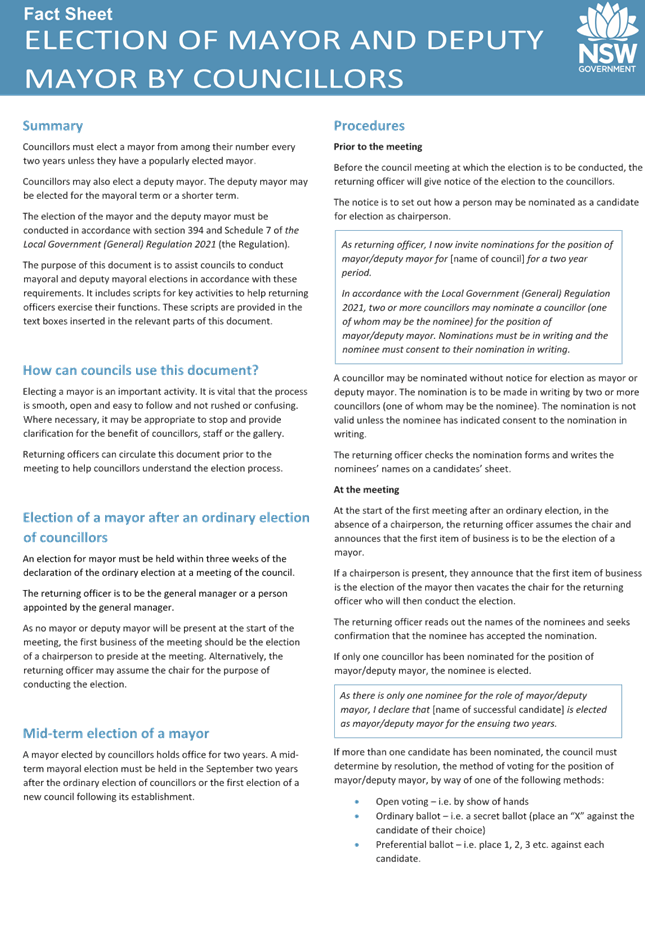
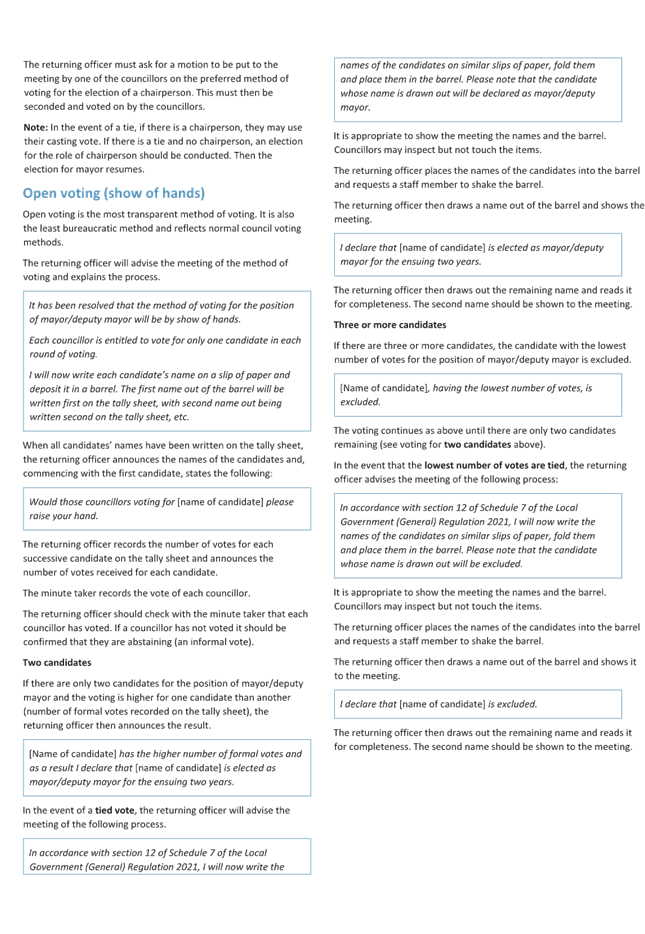
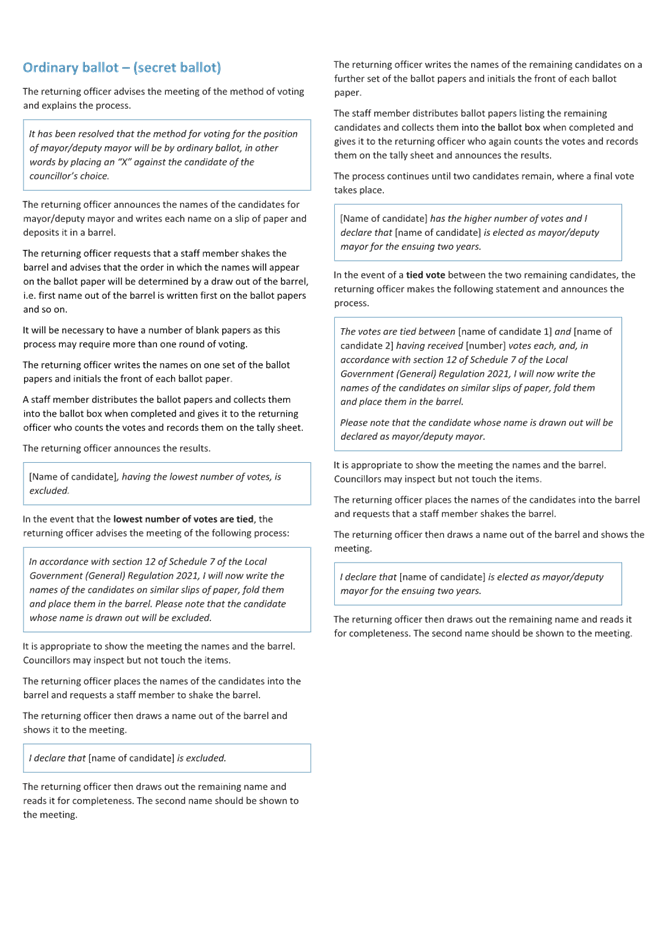
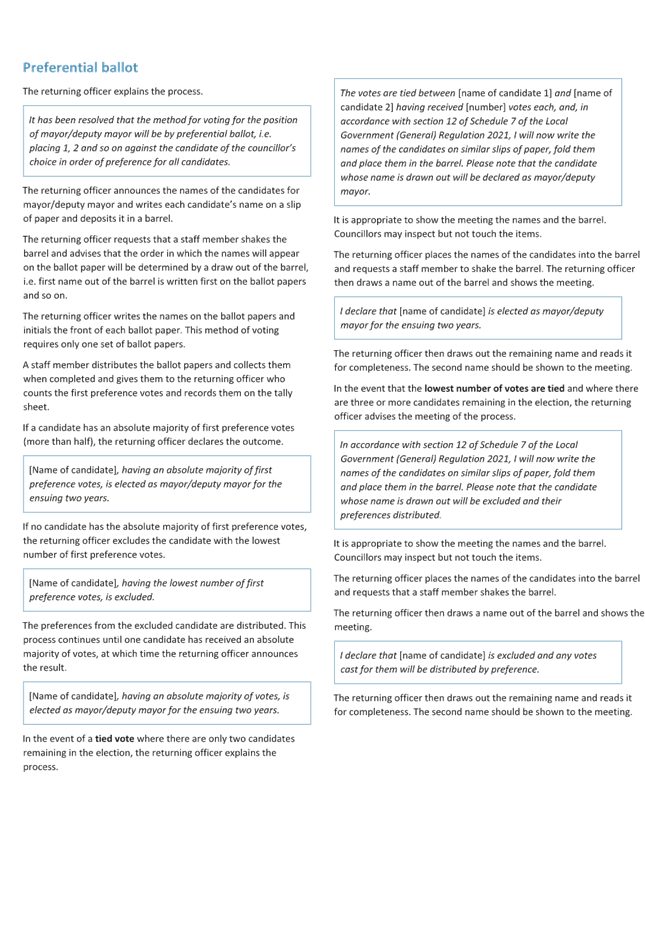
Annexures: A. Office
of Local Government Election of Mayor and Deputy Mayor by Councillors Fact
Sheet ⇩ 
|
0BRecommendation
That Council:
1. Note
the information on the process for the election of Mayor and Deputy Mayor to
be held at the 8 October 2024 Extraordinary Council meeting.
2. Elect
a Deputy Mayor for the same term as the Mayor.
3. Adopt
the Ordinary Ballot system of voting if an election is required for the
position of Mayor or Deputy Mayor.
4. Record
the names of the successful candidates for Mayor and Deputy Mayor in the
minutes for this meeting
|
Background
The Local Government Act provides that when a Mayor is not
(popularly) elected by voters at a general election, Councils are to elect a
Mayor from their number on a bi-annual basis in the month of September (Section
290). Councils may also elect a Deputy Mayor from their number for the same or
lesser term as the Mayor (Section 231). The Deputy Mayor may exercise any
functions of the Mayor at the request of the Mayor or if the Mayor is prevented
by illness, absence or otherwise from exercising the functions of his/her
Office. It is customary to elect a Deputy Mayor who is appointed for the same
term as the Mayor.
ISSUES AND COMMENTARY
The election of the Mayor and Deputy Mayor for the period
from 8 October 2024 through to the September 2026 Ordinary Council Meeting (two
(2) year term), will take place at the extraordinary meeting of Parkes Shire
Council scheduled for Tuesday 8 October 2024.
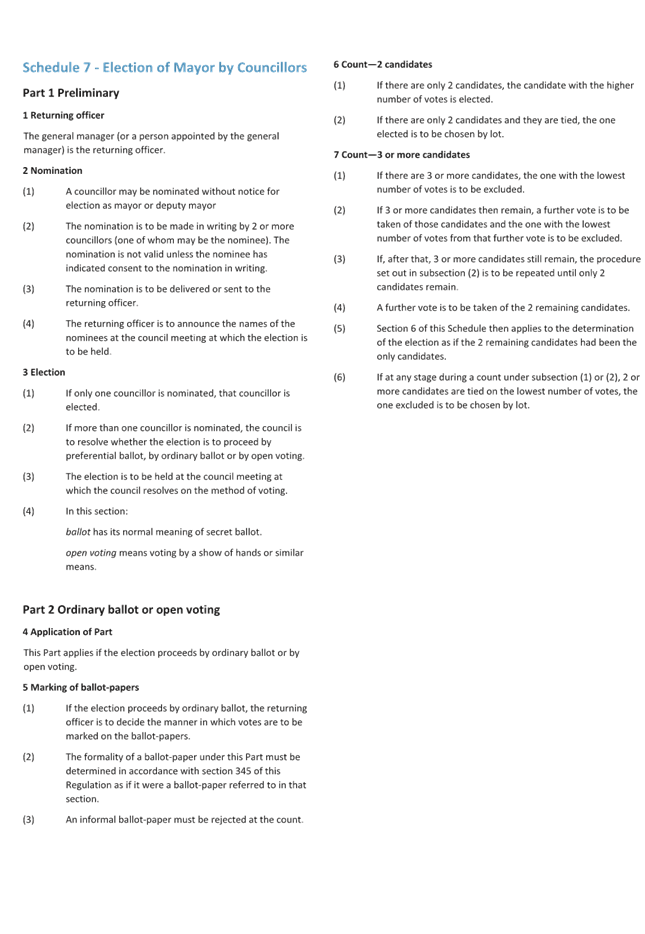
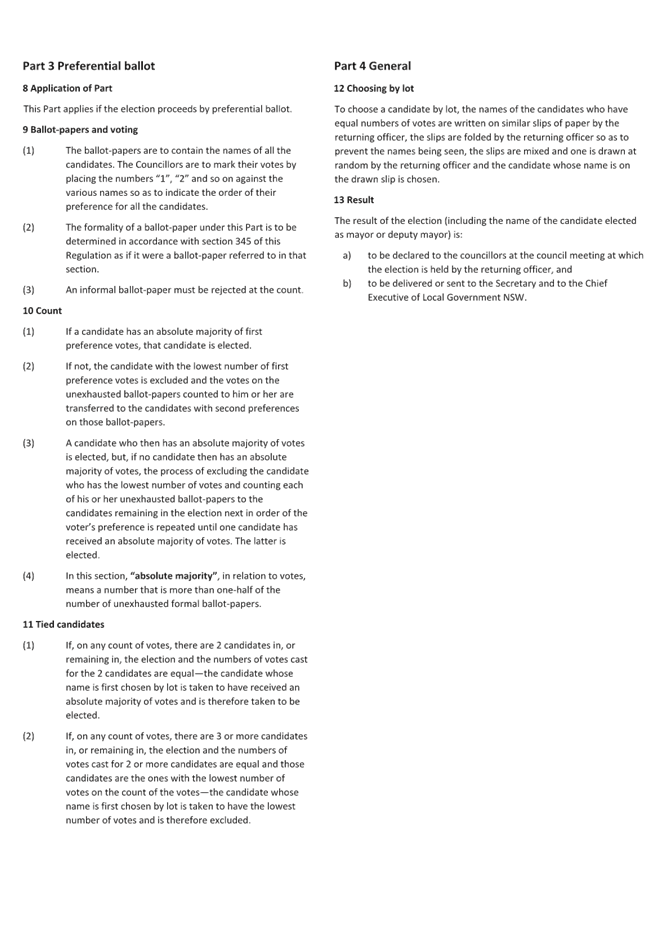
A summary of the election procedure is listed below for the
information of Councillors. This information is detailed in the Office of Local
Government's "Fact Sheet - Election of Mayor and Deputy Mayor"
("Fact Sheet") included as Annexure A. The Fact Sheet provides
more details of the process and includes an extract of Schedule 7 of the Local
Government (General) Regulation 2005.
Summary of Election Process
Prior to Election
· A nomination for the Office of
Mayor or Deputy Mayor is to be made in writing by two or more Councillors (one
of whom may be the nominee). The nomination is not valid unless the nominee has
indicated consent to the nomination in writing. To assist Councillors
nomination requisite forms are attached to this report at Annexure B and
will be distributed at this meeting.
· The General Manager or a
person appointed by the General Manager is the Returning Officer. The General
Manager has appointed Anthony McGrath Director Customer, Corporate Services and
Economy as the Returning Officer for this election. Nominations are to be
delivered or sent to the Returning Officer prior to the commencement of the 8
October 2024 extraordinary council meeting.
Election Day
The General Manager will take the Chair for the meeting and
will hand over to the Returning Officer to conduct the election at the
appropriate time. If any procedural matters are required with reference to
Council’s Code of Meeting Practice (such as the need for a short
adjournment etc) during the election process, the General Manager will carry
out those requirements “From the Chair”.
The Election
· The Returning Officer will
call for further nominations without notice. If a nomination without notice is
made, it must be accepted in writing by the nominee to be valid. The nomination
is to be given to the Returning Officer. Additional Nomination forms will be on
hand at the meeting if required.
· If no further nominations
without notice are received, the Returning Officer will read out the
nominations received.
· If only one Councillor is
nominated, that Councillor is elected. If more than one Councillor is
nominated, the Council resolution relating to the method of voting will apply.
The Council will have resolved whether the election is to proceed by:
a) Preferential
Ballot
b) Ordinary
Ballot
c) Open
Voting (show of hands)
· Councillors can participate in
mayoral elections using an open voting method by audio visual link but not if
either of the other two methods of election are used. That is, if the
council elects to conduct the election by either of the secrete methods, those
on audio-visual links will not be able to participate in the election.
· Ordinary and preferential
ballots are secret ballots and Councillors will need to attend the meeting in
person to vote if using either of these methods.
· If the method is by
preferential or ordinary ballot, it shall be by secret vote. Traditionally
Council has adopted the ordinary ballot process for elections. For a
detailed explanation of the different methods of voting, please refer to the
Fact Sheet at Annexure A.
Under the ordinary ballot System, the election is carried
out as follows:
· The Returning Officer is to
decide the way votes are to be marked on the ballot-papers. If the ordinary
ballot system is chosen, Councillors are asked to carefully read and follow the
instructions on the ballot paper to avoid informality.
· If there are only two
candidates, the candidate with the higher number of votes is elected.
· If there are three or more
candidates, the one with the lowest number of votes is to be excluded. (The
legislation attempts to bring the vote back to a contest between two
candidates. Thus, the requirement is to exclude the candidate with the lowest
number of votes If there are three or more candidates).
· If after the first exclusion
three or more candidates then remain, a further vote is to be taken of those
candidates and the one with the lowest number of votes from that further vote
is to be excluded. If, after that, three or more candidates remain, separate
ballots continue until only two candidates remain.
· When only two candidates
remain, election of the candidate is in accordance with the procedure mentioned
above for two candidates.
· If at any stage during a count
where there are three or more candidates and two (or more) candidates are tied
on the lowest number of votes, the one excluded is to be chosen by lot.
For a detailed explanation of preferential voting, refer Annexure
A.
The formality of a ballot paper under this provision is to
be determined in accordance with the Regulation. As mentioned above Councillors
are requested to carefully read the instructions on any ballot paper to avoid
the chance of informality. If a vote is declared informal by the Returning
Officer, it is set aside and cannot be used in the count.
At any stage that a ballot is required, ballot papers will
be prepared and distributed to Councillors for marking:
· Upon completion of marking of
the ballot papers by Councillors, the ballot papers will be collected on behalf
of the Returning Officer and the votes will be counted.
· When the ballot or ballots, as
required pursuant to the provisions of the Regulation, have been completed and
a result obtained, the Returning Officer will announce the results to the
meeting.
The Returning Officer’s declaration finalises the
election for the position.
Tied Candidates
· If, on any count of votes,
there are two candidates in, or remaining in, the election and the numbers of
votes cast for the two candidates are equal the candidate whose name is first
chosen by lot is taken to have received an absolute majority of votes and is
therefore taken to be elected.
· If, on any count of votes,
there are three or more candidates in, or remaining in, the election and the
numbers of votes cast for two or more candidates are equal and those candidates
are the ones with the lowest number of votes on the count of the votes the
candidate whose name is first chosen by lot is taken to have the lowest number
of votes and is therefore excluded.
Choosing by lot
To choose a candidate by lot, the names of the candidates
who have equal numbers of votes are written on similar slips of paper by the
Returning Officer, the slips are folded to prevent the names being seen, the
slips are mixed and one is drawn at random by the Returning Officer and the
candidate whose name is on the drawn slip is chosen.
Election of Deputy Mayor
· The nomination and election of
the Deputy Mayor is carried out in the same manner as the nomination and
election of the Mayor.
Legislative and Policy Context
The NSW local government Acts and Regulations that are
applicable to the election process are as follows:
Local
Government Act, 1993 Section 290 Provision for Election of Mayor
Local
Government Act, 1993 Section 231 Provision to elect a Deputy Mayor
Local
Government General Regulation 2005 (Schedule 7) Procedure to Elect
Local
Government (General Regulation) 2005 Clause 394 Power to elect
Financial Implications
There are no financial implications for Council associated
with this Report.
Risk Implications
Following the process as described in this report ensures
that Council meets its compliance requirements under the Local Government Act.
Community Consultation
There are no community consultation requirements for Council
associated with the Report.
Conclusion
The election of the Mayor and Deput Mayor will take place at
the Ordinary Meeting of Council to be held on 8 October 2024. This report
outlines the election method and process, and recommends that Council choose a
method of voting, should an election for the position of Mayor or Deputy Mayor
be required.
|
Extraordinary
Council Meeting Agenda
8
October 2024
|
|
Extraordinary Council Meeting Agenda
8 October 2024
|
11 Reports
of the Director Customer, Corporate Services and Economy
11.1 Use of a Countback
to Fill a Casual Councillor Vacancy
IP&R
Linkage: Pillar: Leadership
Goal: Our local government
is contemporary, effective and efficient.
Strategy: Ensure
compliance with statutory requirements and ensure Parkes Shire Council’s
operations are supported by good corporate governance and effective risk
management.
Author: Nikki
Bevan, Acting Manager Governance, Risk and Corporate Performance
Authoriser: Anthony
McGrath, Director Customer, Corporate Services and Economy
Annexures: A. Countback
Information Sheet - NSW Electoral Commission ⇩ 
|
Recommendation
That Council:
1. Pursuant to
section 291A(1)(b) of the Local Government Act 1993, declare that casual
vacancies occurring in the office of a councillor within 18 months after the
last ordinary election of councillors for the Council on 14 September 2024,
are to be filled by a countback of votes cast at that election for the office
in accordance with section 291A of the Act and directs the General Manager to
notify the Electoral Commissioner for NSW of Council's decision within 7 days
of this decision.
|
Background
Councils have the option of using a countback of votes cast
at the last ordinary election to fill casual vacancies occurring in the offices
of councillors in the first 18 months after the election.
This will allow Councils to use a countback to fill
vacancies at a lower cost than the cost of holding a by-election.
To exercise the option of using a countback to fill casual
vacancies occurring in the first 18 months following the election, Councils
must resolve, at their first meeting after the election, to use a countback to
fill casual vacancies.
If Councils do not resolve this at the first meeting after
the election, they will be required to fill casual vacancies through a
by-election.
ISSUES AND COMMENTARY
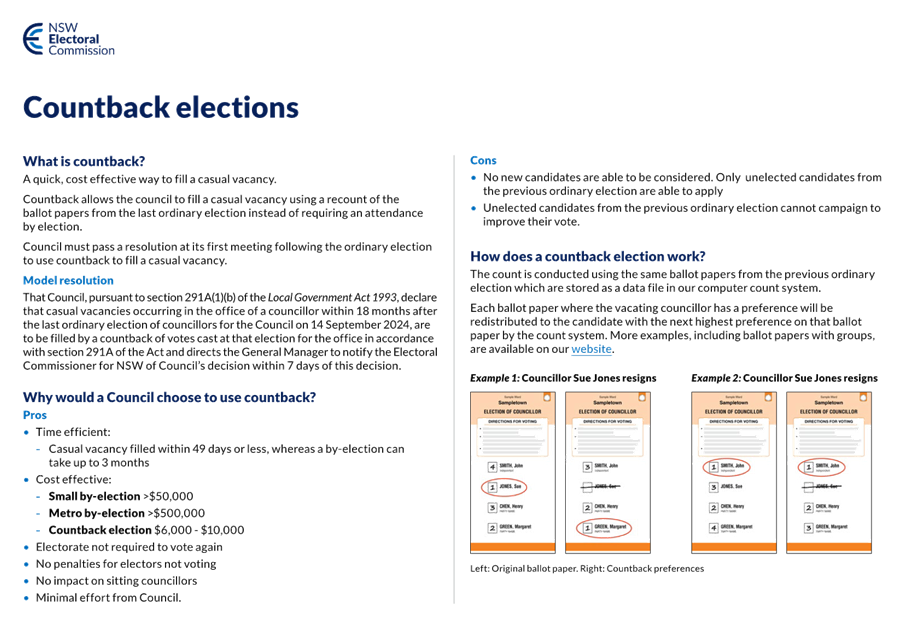
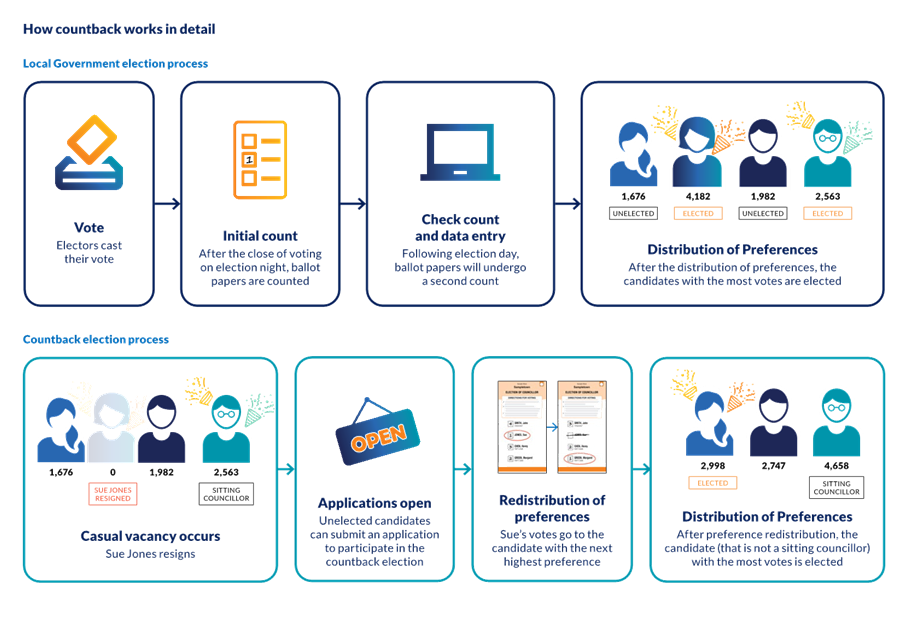
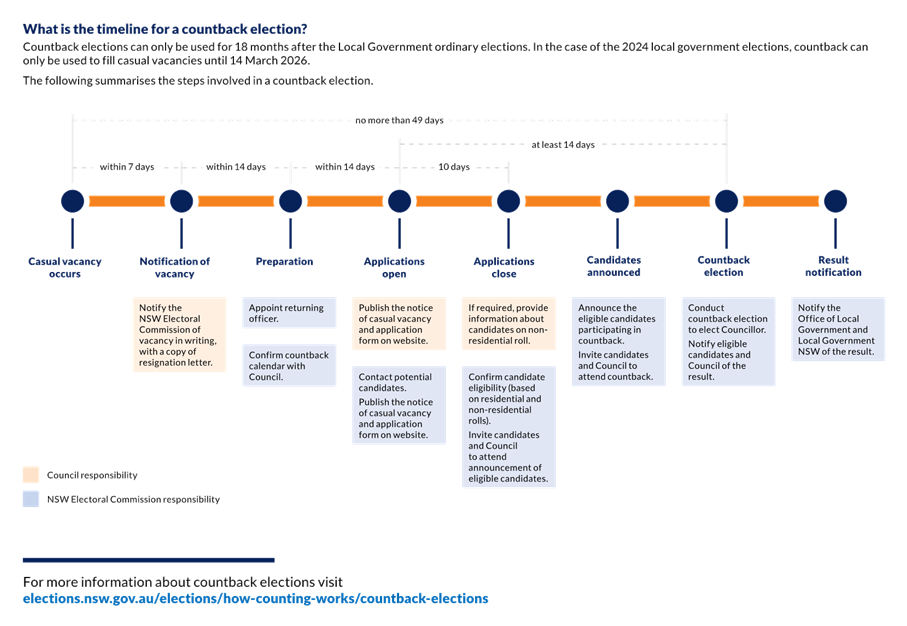
The NSW Electoral Commission Countback Information Sheet,
appended as Annexure A, describes the countback process.
A countback election is used to elect a councillor to fill a
casual vacancy, where the vacating councillor was elected under the
proportional representation method (i.e. where two or more candidates were
elected at a local government (ordinary) election). If there are multiple
vacancies, a separate countback election is held for each vacancy.
A countback election has no impact on sitting councillors.
Potential candidates are those unelected from the ordinary
election. The returning officer contacts all unelected candidates who may still
be eligible to be elected. Interested candidates must submit a formal
application.
Any candidates that do not apply to participate in the
countback election (non-participating) cannot be elected.
If there are no eligible candidates, an attendance
by-election must be held. If there is only one eligible candidate, that
candidate is elected. If there are multiple eligible candidates, a countback
election is conducted.
How a Countback works
The countback election will be run using the same ballot
papers from the last ordinary election.
In the ordinary election, the preferences shown on every
ballot paper are entered into a data file. This data file is used in the
Proportional Representation Count Computer (PRCC) to run the countback
election.
During the countback election for each ballot paper on which
the vacating councillor received a preference, that preference is allocated to
the candidate with the next highest preference on that ballot paper.
For ballot papers with groups, if the first candidate in a
group is vacating their seat, the Above The Line preference for that group
would be allocated to the second candidate in that group.
For Below the Line voting, for each ballot paper with a
preference for the vacating councillor, that preference would be allocated to
the candidate with the next highest preference.
When a countback election is conducted, the first
“elected” candidate, that is not a sitting councillor, is the
candidate elected as the new councillor.
If a non-participating candidate (a candidate who did not
apply) is elected, their status is changed to “ineligible” and the
countback is run again. The preferences for this ineligible candidate will be
reallocated accordingly. This process will continue until an eligible candidate
is elected.
Candidates and council representatives can attend the
countback via a Teams link or alternatively can attend in person. The newly
elected councillor(s) and the council are notified of the result.
Casual Vacancy after 18 Months
Note that should a casual vacancy occur after 18 months then
a by-election must be held, unless the vacancy occurs within 18 months of the
next ordinary election in September 2028. In this case, the council may receive
ministerial approval to leave the position vacant until that next election.
Legislative and Policy Context
Section 291A(1)
(a) & (b) of the Local Government Act 1993 provides for the use of a
countback to fill a casual vacancy within 18 months of the election, provided
that the council resolves to do so at the first meeting after the election.
Countback
elections are described in Schedule 9A of the Local Government (General) Regulation 2021.
Financial Implications
The cost of running a countback over the previous ballot
papers from the last election is significantly less than the cost of running a
by-election to fill a casual vacancy. For Parkes Shire, a full by election
would cost more than $100k, whereas a countback is estimated at $6,000 to
$10,000.
Risk Implications
Council will potentially avoid a financial risk associated
with the cost of running a full by-election to fill a casual vacancy.
Community Consultation
There are no community consultation requirements for Council
associated with this report.
|
Extraordinary
Council Meeting Agenda
8
October 2024
|
|
Extraordinary
Council Meeting Agenda
8
October 2024
|
11.2 2024
Local Government Election Results for Parkes Shire Councillors and Declaration
of the Poll
IP&R
Linkage: Pillar: Leadership
Goal: Our local government
is open, accountable, and representative.
Strategy: Provide open and
transparent decision-making and undertake the civic duties of Council with
professionalism and integrity.
Author: Nikki
Bevan, Acting Manager Governance, Risk and Corporate Performance
Authoriser: Anthony
McGrath, Director Customer, Corporate Services and Economy
Annexures: A. Parkes
- First Preference Group and Candidate Votes by Aggregated Vote Type ⇩ 
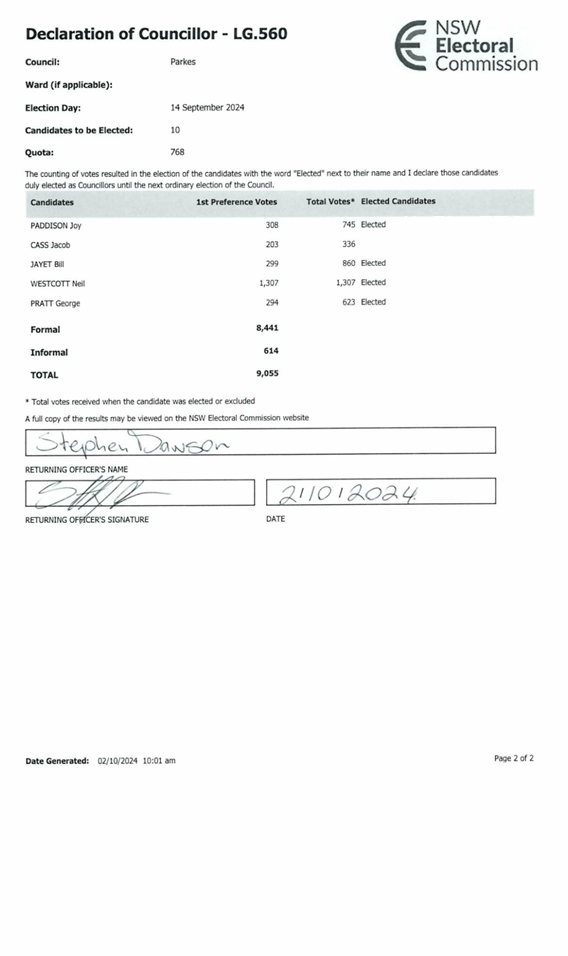
B. Declaration
of Councillor Poll - Parkes Shire ⇩ 
|
Recommendation
That Council:
1. Notes the official
results of the election for councillors held on 14th September 2024 as
published on the NSW Electoral Commission website on 30 September 2024.
|
Background
There are 128 local government councils in NSW. Each council
represents a local government area. The NSW Electoral Commission conducted
elections for 126 councils on Saturday, 14 September 2024. Voting is compulsory
at all NSW local government elections except for council polls. The election
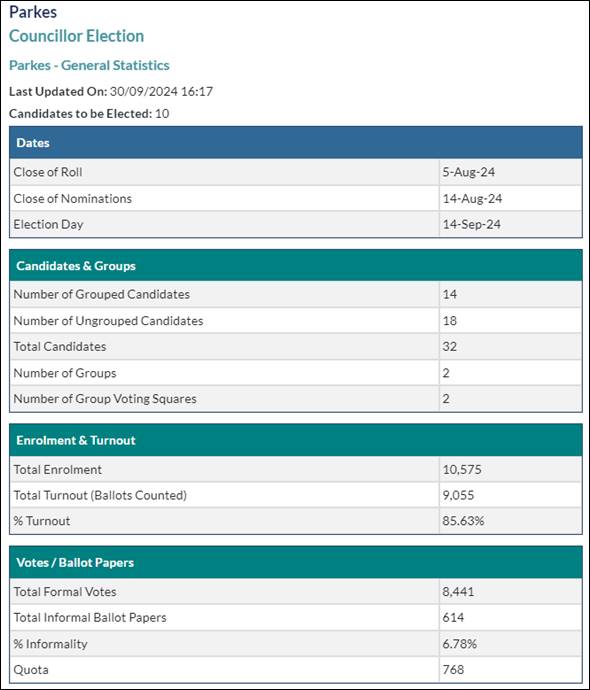
saw a total of 10,575 residential and non-residential electors enrolled, with
9,056 votes cast. The election was conducted using a proportional
representation counting system, and 10 councillors were elected from a pool of
32 candidates.
ISSUES AND COMMENTARY
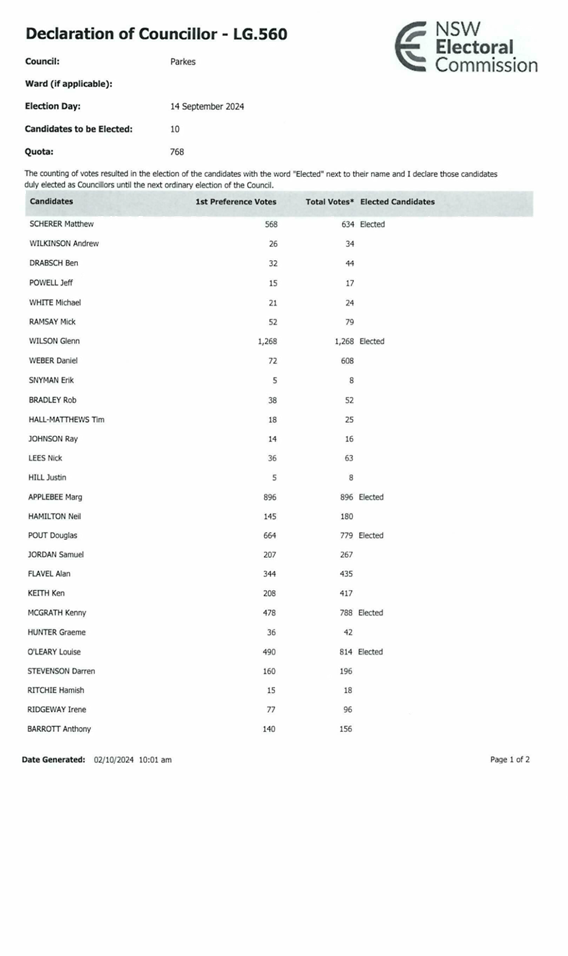
NSW Electoral Commission has officially advised Council (see
Annexure B) that the poll for the election of 10 councillors during the
Parkes Shire local government election, which was held on 14 September 2024,
has been declared. The results of the election were published on their website
at Parkes -
Councillor Election results (nsw.gov.au). The people of Parkes Shire will
now have three new councillors along with seven returning councillors to
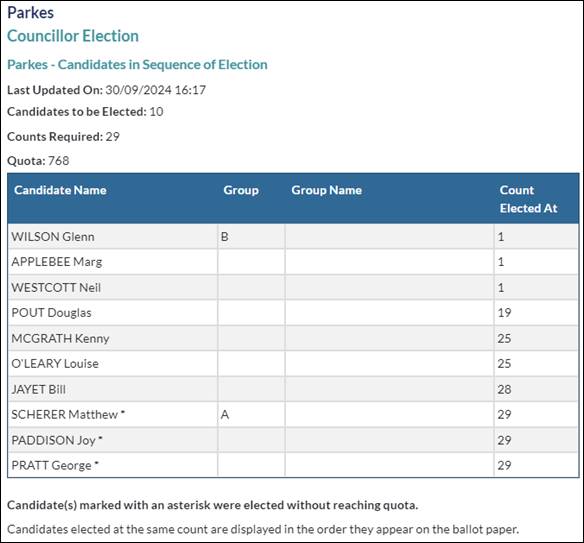
represent them over the next four-year team. The councillors in order of total
preferential votes received when the candidate was elected are:
1. Cr Neil
Westcott
2. Cr Glenn
Wilson
3. Cr Marg
Applebee
4. Cr Bill
Jayet
5. Cr Louise
O'Leary
6. Cr Douglas
Pout
7. Cr Kenny
McGrath
8. Cr Joy
Paddison
9. Cr Matthew
Scherer
10. Cr George Pratt
The website also contains various reports including general
statistics, candidates elected, first preference counts including by polling
place, distribution of preferences, etc.
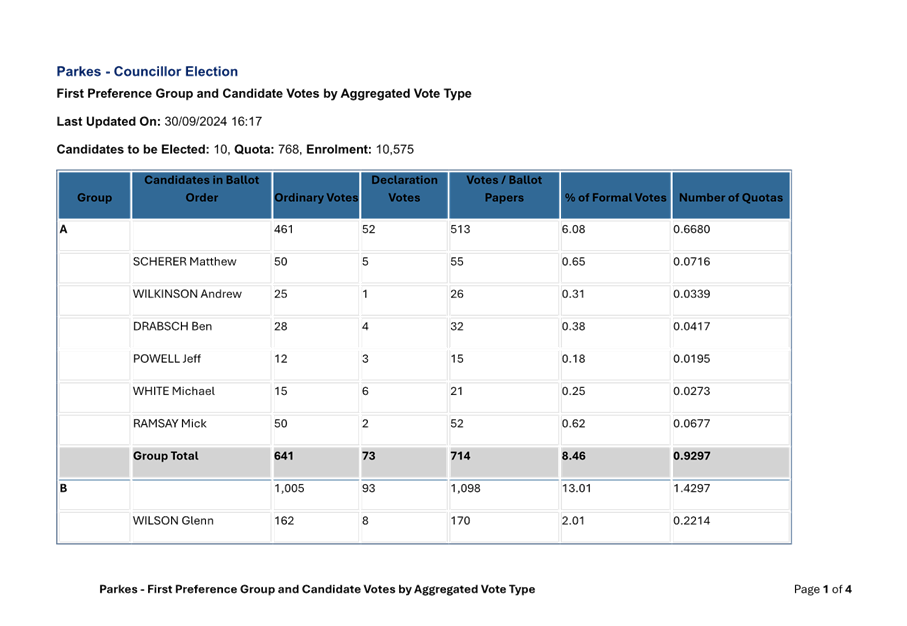
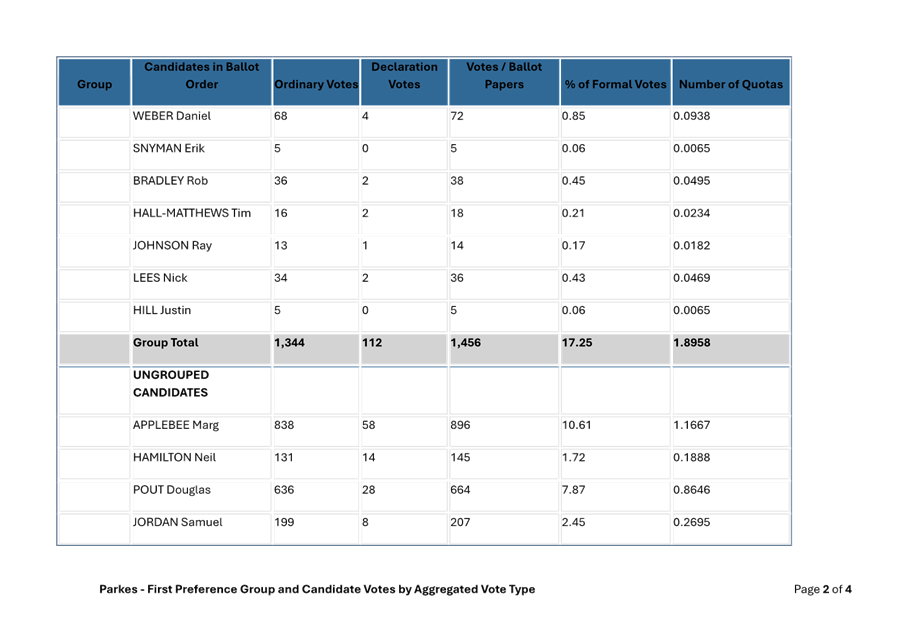
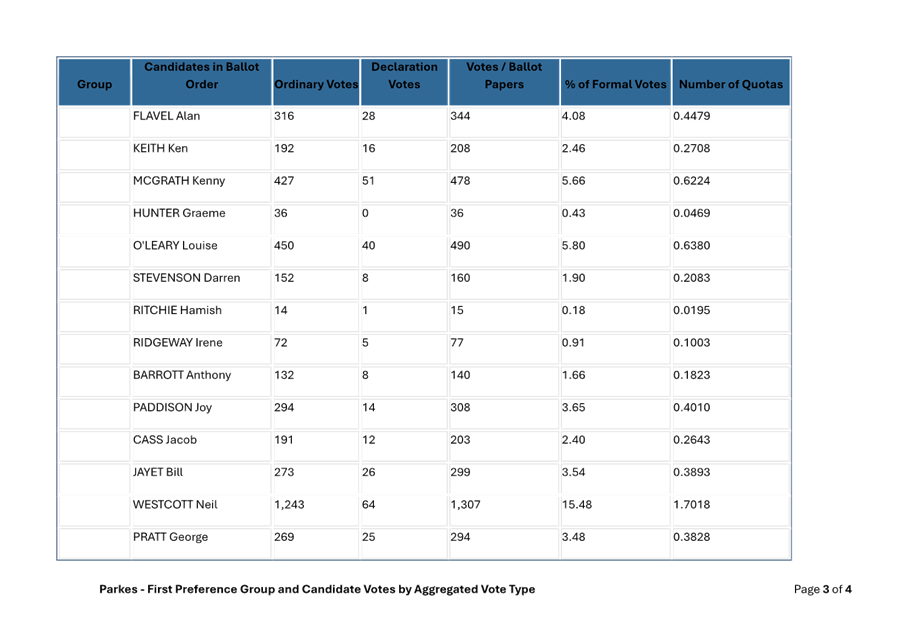
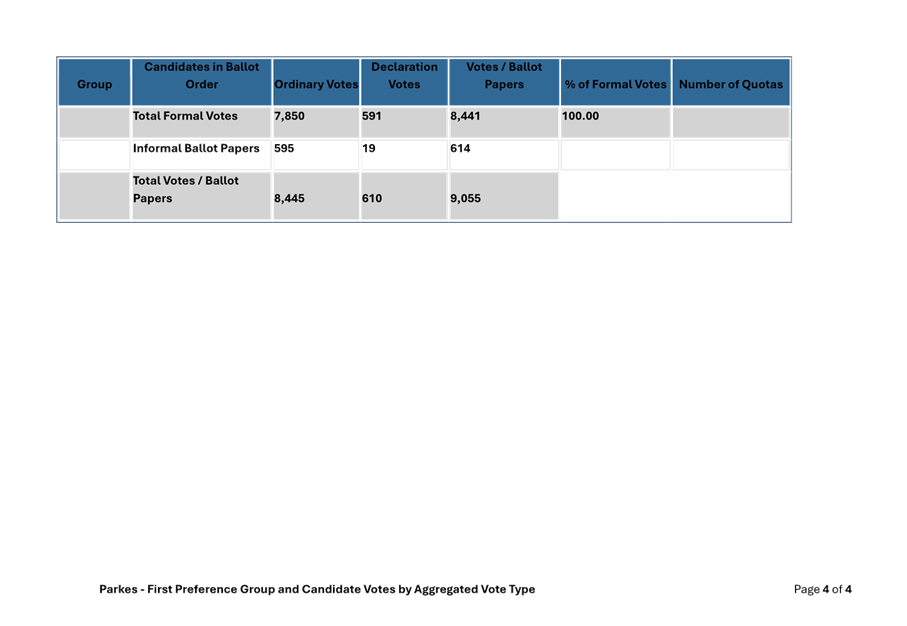
Annexure A "Parkes - First Preference Group and
Candidate Votes by Aggregated Vote Type". Provides a detailed list of the
results for each of the candidates.
Below are some reports from the website.
General Statistics
Candidates in Sequence of Election
Legislative and Policy Context
Local Government Act 1993
Local Government (General) Regulation 2021
Electoral Funding Act 2018 and Electoral Funding
Registration 2018
Financial Implications
Parkes Shire Council contracted the Electoral Commission of
NSW to conduct an ordinary election for 10 councillors. The overall costs will
be more than $100k.
Risk Implications
There are no major risks considerations associated with this
report.
Community Consultation
A public notice
about the declaration of the poll was posted on Council's web site.
|
Extraordinary Council
Meeting Agenda
8 October 2024
|
|
Extraordinary Council
Meeting Agenda
8 October 2024
|
|
Extraordinary Council Meeting Agenda
8 October 2024
|
12 Report
of Confidential Resolutions
In accordance with clauses
14.22 and 14.23 of Council's Code of Meeting Practice, resolutions passed
during a meeting, or a part of a meeting that is closed to the public must be
made public by the Chairperson as soon as practicable. Such resolutions must be
recorded in the publicly available minutes of the meeting.